Hit means requesting an additional card from the dealer in hopes of improving your hand without going over 21. Ask for a “hit” when your current hand is too weak to stand a good chance against the dealer.




The game of blackjack moves fast. Cards fly on the table, and bets are made rapidly. Amid this, you have to make decisions in seconds. One of the most important choices you’ll make in any hand is when to hit or stand in blackjack. This means whether to ask the dealer for another card to improve your hand or to “stand” and refuse more cards.
The main goal in blackjack is to make a hand with a total as close to 21 as possible. You play against the dealer (not other players) and have to beat their hand. That’s why the hit or stand blackjack strategy is important.
Here’s what these two terms mean:
| Action | Meaning | When to Use |
| Hit | Take another card | When your hand is weak, or the dealer has a strong card. |
| Stand | Keep your current hand | When your total is strong, or the dealer shows a weak card. |
Pro tip on how to ask for a hit or stand: If you want a hit, indicate your decision by scratching your index finger on the table from front to back. If you want to stand, wave your hand, palm down, over your playing cards. In online games, you only have to click on the hit or stand buttons.
This may sound straightforward, but deciding between hit or stand can be a lot of pressure when you are in the middle of the game. You cannot afford to go with your intuition when real money is on the line.
For example, you have a King and a three, which is worth 13 points. The dealer has a 9 as his face-up card. What do you do? At first glance, it’s clear that the combination is stronger than 9. So, you might choose to stand because you don’t want to risk busting. But many players forget that even though 9 is not a face card, it is still strong. If the dealer has a face card in the hole (the second card, which the dealer keeps face down), it will give them a total of 19. If you stand at 13, you are most likely to lose.
Many professional gamblers in this situation will hit. Yes, you risk busting, but you also have a chance to draw high cards between 5 through 8, which will give you a much stronger hand. So, you have to play the odds, not just play it safe.
The hit or stand decision comes up with every single hand. Don’t treat it as a small choice because it impacts your overall results. In fact, mastering this strategy can slightly reduce the house edge because you become skilled at predicting different outcomes and making the right calls.
Below, we give you strategy charts, tips, and rules of thumb to overcome the hit or stand dilemma. We’ll also tell you about blackjack hand values and blackjack mistakes to avoid.
Blackjack is not just a game of luck. You can potentially beat the odds with skill, practice, and knowing when to make the right move. One way to get better at blackjack is to understand the hands you are dealt and what the dealer’s upcard tells you. Let’s break it down:
Sometimes, two hands with the same total can play out very differently. That’s where the concept of soft and hard hands comes in.
For example,
They both total 17. However, the hand value is not equal because the Ace can have different values in Blackjack. It can be counted as either 11 or 1. A soft hand means your Ace is currently being counted as 11. If you hit and get a high card (like a 10), the Ace can switch to being worth 1, so you don’t bust. That’s why a card combination with an Ace is called a “soft” hand – the total can be moulded as per requirement.
There’s no wiggle room in hard hands. In the second example, the total remains 17. That’s already close to 21. So, if you hit (draw another card) on a hard 17, you are very likely to lose. For example, in a hard 17, only A, 2, 3, and 4 will be useful, while 5, 6, 7, 8, 9, 10, and all the face cards (also valued at 10) will make you go bust. Clearly, there’s a high chance of drawing bigger cards, so, in this scenario, hitting is the wrong move.
Strategy-wise, soft hands give you more flexibility. You can afford to take another card without as much risk. Even the most basic strategy charts say to hit a soft 17, but to stand on a hard 17.
Hands totaling 12 through 16 are tricky. Hit, and you might bust. Stand, and you might just be giving the dealer a free win.
For example, you have a 10 and a 6. It’s too low to stand, but too high to hit. What do you do? Well, it depends on the dealer’s upcard. If the dealer has a weak upcard, take a chance and call for a hit. However, if he has a strong card like an Ace or 10, then it is better to stand.
Aces are powerful cards in blackjack because they can count as either 1 or 11. That flexibility changes everything. For example, if you have a hard 16 (10 and 6), then the hit or stand decision can be a dilemma. However, with a soft 16 (Ace and 5), the decision becomes easier. Ask for a hit, and if you get a high card, switch the value of Ace back to one.
Players are dealt both cards face up. They can continue asking for hits until they are satisfied with the total and call “stand”. Meanwhile, the dealer has only one card face up, while the other card remains face down. When the player stands, the dealer reveals his other card. The dealers are required to keep hitting till the total reaches at least 17.
So, how do players use the dealer’s upcard to their advantage? Let’s go through the possibilities:
The dealer must hit until they reach at least 17. That’s not a choice, it’s a rule. So, even if they have 16, they’ll have to hit. They must stand once the total reaches 17. Some casinos require the dealer to hit again if the total is a soft 17, so always check the table rules.
Always keep this rule in mind because it helps predict how the dealer’s hand might develop. For example, the dealer shows a 4, and you have a 12. Consider standing, hoping they bust. But if the dealer shows a Queen, consider hitting, trying to improve your hand because they’re likely to make 21.
Some hands can be tricky. For example, do you hit or stand in blackjack 15, or do you hit or stand in blackjack 16? It’s not always obvious what to do. That’s where a blackjack strategy chart comes in handy. This simple tool will help you make the smartest decision based on your hand and the dealer’s upcard. Let’s break it down.
Key:
“Double” means you double your original bet and receive only one more card. It’s a strong move when the odds are in your favor. For example, you have a 10, the dealer shows a 5. You have a high chance of winning the round, so you can opt to double your bet. However, not all casinos allow doubling on every hand. So, if doubling is not an option, then you stand (Ds in the chart)
“Split” comes into play when you’re dealt a pair (two cards of the same rank). Choosing to split means you separate the pair into two hands. To split, you’ll need to place an equal bet for the second hand.
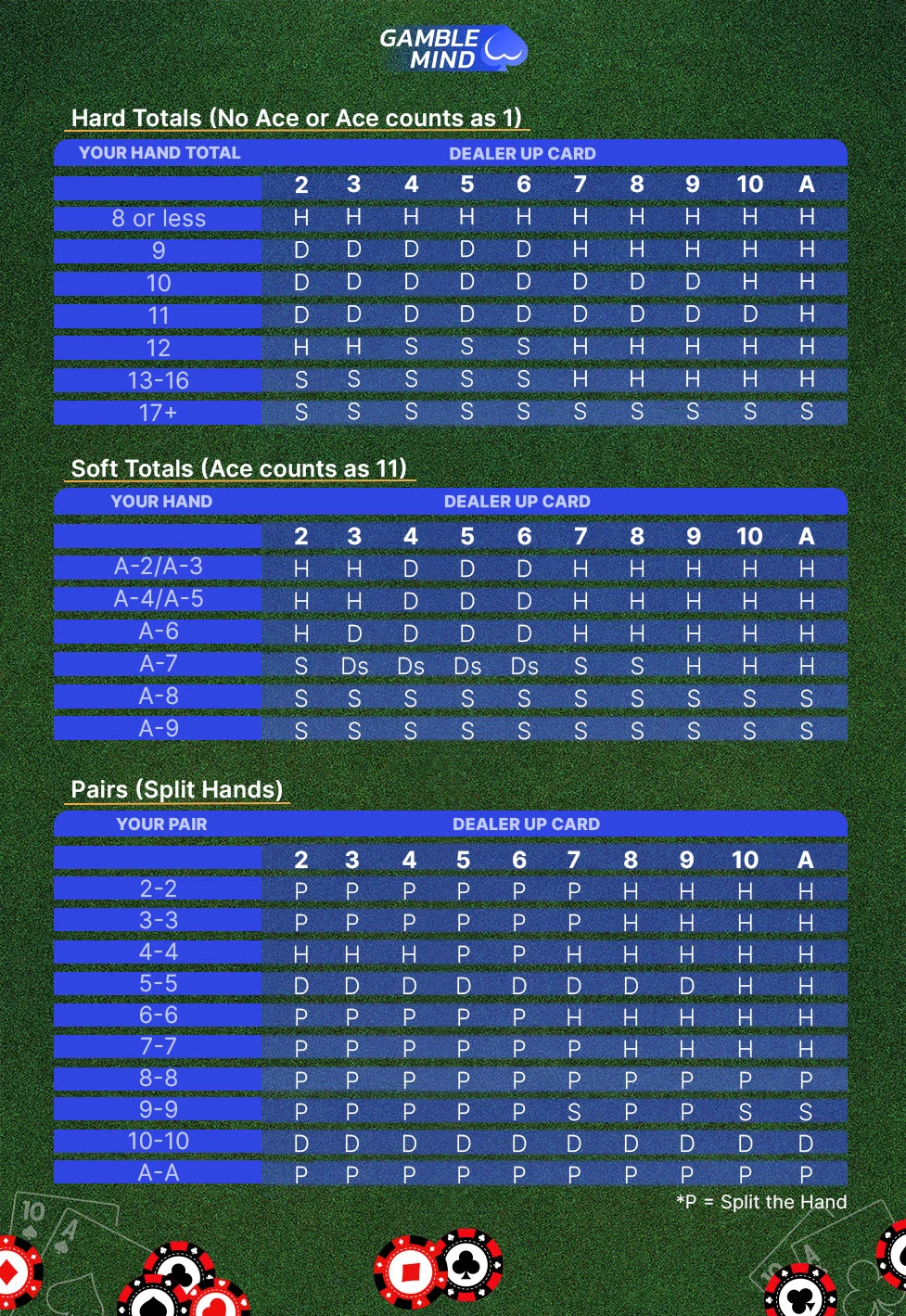
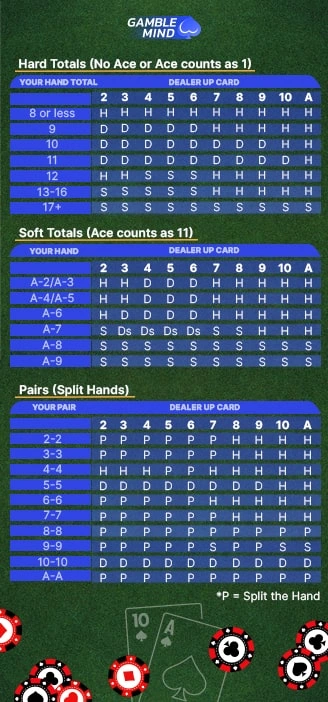
Note: Practice these charts in demo mode first to improve decisions and reduce costly mistakes in live games. You can download our charts and even print it to have them always with you when you play.
While using the strategy chart based on blackjack hand values is a good place to start, you can also try some betting systems:
Let’s walk through a few common situations that often trip players up:
The decision to hit or stand on blackjack 16 depends on the dealer’s card.
In short, when the dealer’s strong, you fight. When they’re weak, you wait.
Soft hands, where an Ace counts as 11, give you more flexibility because you can’t bust with one hit. It’s soft because you have the flexibility of counting it as 1, depending on the next card you hit.
Your approach to blackjack should change depending on whether you are a casual player or like to play longer sessions like tournaments. Here’s how:
Doubling down means doubling your original bet in exchange for receiving only one more card. For example, you’re dealt a 6 and a 5, totaling 11. The dealer is showing a 6. This is a good doubling opportunity as you’ve got a good shot at landing a 10 for 21. Double down when the odds are in your favor.
When to Double Down
When you’re dealt a pair, you have the option to split them into two separate hands and place equal bets on both. This gives you two chances to beat the dealer.
When to Split:
You don’t have to memorize every move in blackjack. Practice the most common scenarios on mobile apps, simulators, and interactive trainers. The more you practice, the better you’ll get.
Hit means requesting an additional card from the dealer in hopes of improving your hand without going over 21. Ask for a “hit” when your current hand is too weak to stand a good chance against the dealer.
You should “stand” or stop taking more cards when your hand is strong enough (usually 17 or higher). You can also decide to stand based on the dealer’s upcard. When the dealer’s upcard is weak, it is better to stand.
Basic strategy provides the mathematically optimal play for every situation. While it doesn’t guarantee a win every hand, it significantly reduces the house edge compared to playing based on intuition alone.
One of the most common mistakes is standing too early on low totals like 12–14, especially when the dealer shows a strong card (7–Ace). This often gives the dealer an advantage, as the player fails to improve their hand.
Yes. The dealer’s upcard is a critical factor in blackjack strategy. The dealer has to keep hitting their cards till they reach a total of 17 or more. If they have a low card, they are more likely to bust as they need to hit more. In this scenario, it is better to stand. If their upcard is strong, continue hitting to improve your total.










We inform you that this website uses cookies. To consent, click the ‘Agree’ button or continue browsing. To learn more about our privacy policy, click here.